Venture Case Study
FounderSpace: from opportunity to working product
FounderSpace turns an early business idea into a structured validation brief covering the problem, market, demand signals, users, competition, positioning, and next decisions. Origin Studios connected business validation, product strategy, AI-assisted information sourcing, software delivery, offer design, and launch so assumptions could meet real user and payment evidence quickly.

Written by Radu Benga · Reviewed by Vlad Covaci
Last reviewed
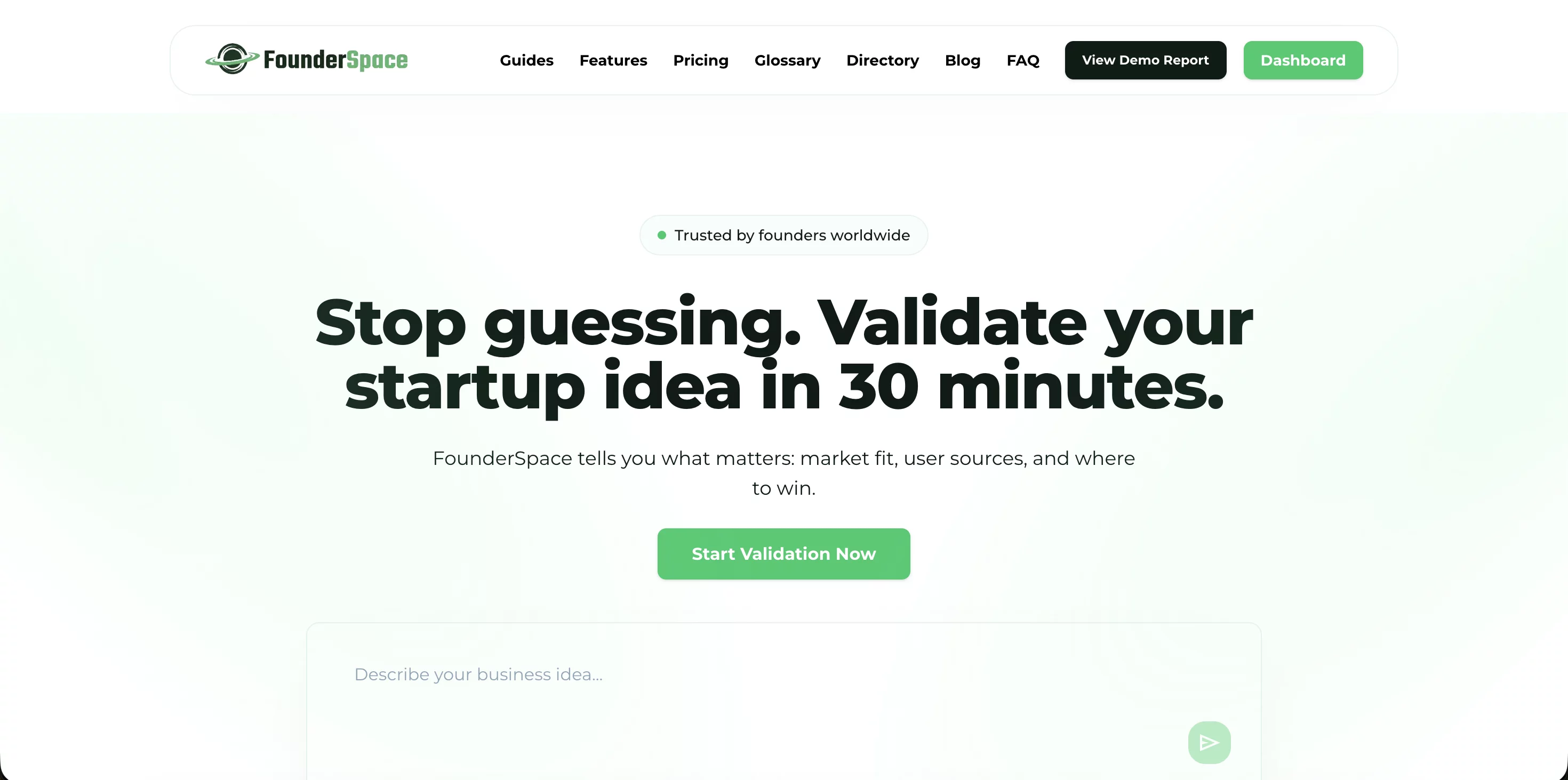
Product overview
What FounderSpace is
A workspace for founders to validate a business idea and grow it.
Industry: Startup validation software
Venture type: Origin Studios venture
Intended audience
Who it was built for
Early-stage founders validating and developing a business idea.
Starting context
Founders often hold an idea, notes, searches, conversations, and assumptions in separate places. Before investing in a larger product, they need a structured way to examine the problem, audience, market signals, alternatives, and positioning.
Problem and opportunity
Founders need a structured way to gather useful information, test assumptions, and turn scattered work into clear next decisions.
Create one founder workspace that turns a plain-language idea into a consistent first-pass validation brief and a clearer next decision, while keeping direct customer conversations and founder judgment in the loop.
Initial hypothesis
If founders could move from a vague idea to a structured evidence brief quickly, they would be better able to identify weak assumptions, find relevant users, sharpen positioning, and decide what to test next—and some would pay for that immediate decision support.
Relevant constraints
- The first product needed to cover a complete validation workflow without becoming a general business-planning suite.
- AI-supported research had to produce structured, reviewable outputs rather than an open-ended chat transcript.
- Customer access, pricing, payment, and feedback needed to be ready alongside the core product.
- The product had to make its limitations clear: desk research should complement, not replace, direct customer evidence.
Origin Studios’ role
- Business problem and opportunity definition
- Product strategy, minimum workflow, and validation model
- AI-assisted information sourcing and structured analysis
- Software product design, development, testing, and launch
- Offer, payment, onboarding, and early-user feedback
Strategy and decision process
- 01
Decision 1
Begin with the founder decision, not a broad collection of startup tools.
- 02
Decision 2
Structure the product around repeatable validation dimensions: problem, timing, proof signals, demand, users, competition, positioning, and next actions.
- 03
Decision 3
Make a complete report the first meaningful outcome so value can be understood and tested quickly.
- 04
Decision 4
Connect launch and payment to the initial product rather than postponing commercial evidence.
Product scope
- Plain-language idea input
- AI-assisted research across multiple validation dimensions
- Structured validation report and executive summary
- Problem, market, audience, competition, demand, and positioning sections
- Shareable output and a pay-as-you-go offer
What was built
- A web product that accepts an idea and orchestrates a structured validation workflow
- A report experience with executive summary, evidence areas, and next actions
- Specialized research and output formats for repeatable product decisions
- Account, report sharing, payment, and product onboarding flows
AI and technical implementation
- AI agents coordinate research and analysis across market viability, problem-solution fit, target audience, and competitive positioning.
- The implemented workflow turns source material into consistent report sections rather than leaving the founder to assemble prompt outputs manually.
- The public product provides shareable briefs and a working payment flow.
Validation and launch approach
- Tested the product with real founders rather than relying only on internal evaluation.
- Used product behavior, report use, feedback, and payment as different evidence types.
- Kept the first workflow narrow enough to learn from early usage and change the product quickly.
Go-to-market work
- Defined an immediate validation outcome that could be explained without a long implementation cycle.
- Connected the first-user route, onboarding, offer, and payment to the product launch.
- Used early testing users and paying customers as inputs for continued product decisions.
Results and outcomes
Results and outcomes
- 60 hours from idea to paying customers
- 100 testing users in the first five days
- Idea validation with 10 paying customers
Evidence register
Evidence behind the case study
| Claim or outcome | Evidence type | Evidence source | Date or period |
|---|---|---|---|
| FounderSpace is a working AI-assisted startup validation product | Live product implementation | FounderSpace public product page ↗ | Not separately recorded |
| The interface contains idea input, AI analysis, structured reports, and validation dimensions | Product implementation and screenshot | FounderSpace public product and existing repository screenshot ↗ | Not separately recorded |
| 60 hours from idea to paying customers | First-party launch and customer record | Origin Studios internal venture records | Not separately recorded |
| 100 testing users in the first five days | First-party launch and product record | Origin Studios internal venture records | First five days |
| Idea validation with 10 paying customers | First-party payment and customer record | Origin Studios internal venture records | Not separately recorded |
Internal sources are first-party Origin Studios records. Public links and interface images show the implemented product; they do not independently audit internal performance records.